- Home
- About Us
- Services
- TaskOps – On-Demand Project Services for Precision & Efficiency
- FlowOps – Optimizing Workflow & Process Automation
- PeopleOps – Building Stronger Teams & Scalable Workforce Infrastructure
- SalesOps – Optimized Sales Strategy & Revenue Growth
- TechOps – Connected Tools, Clean Data, Real-Time Control
- IntegrationOps – Unifying Processes, Technology & Asset Management
- SmartOps – AI, Automation & Smart Data for Operational Excellence
- Work
- Resources
- Team
- Contact Us
“Your people aren’t the problem — the structure, roles, and training you gave them are.”
Most growing companies don’t hit a “capacity ceiling” because their people can’t perform.
They hit it because roles are unclear, leadership expectations are undefined, training is inconsistent, and hiring happens reactively instead of by design. The result is a team that feels overwhelmed, managers stuck in the work, and labor costs rising faster than output.
PeopleOps designs the structure behind your team so people can perform at scale: clear roles, defined ownership, intentional leadership layers, training systems, and capacity models tied to real volume — so growth doesn’t depend on heroics.
What PeopleOps delivers:
1. Clear structure and role ownership so everyone knows what they own, how they contribute, and where accountability starts and stops
2. Leadership and training systems that turn managers into builders of teams — not permanent bottlenecks
3. Labor and capacity models tied to volume so hiring decisions are planned, budgeted, and aligned to growth goals — not made in panic
What PeopleOps Is
PeopleOps is the design of your team structure so your company can grow without breaking.
It focuses on:
- Clear role and ownership design
- Intentional leadership layers
- Training systems that scale people
- Capacity and labor cost tied to volume
PeopleOps turns people from a cost center into a planned production system.
What PeopleOps Is Not
- It is not HR administration
- It is not culture workshops
- It is not generic job descriptions
- It is not “just hire better people”
PeopleOps fixes structure, roles, training, and capacity — not personalities.
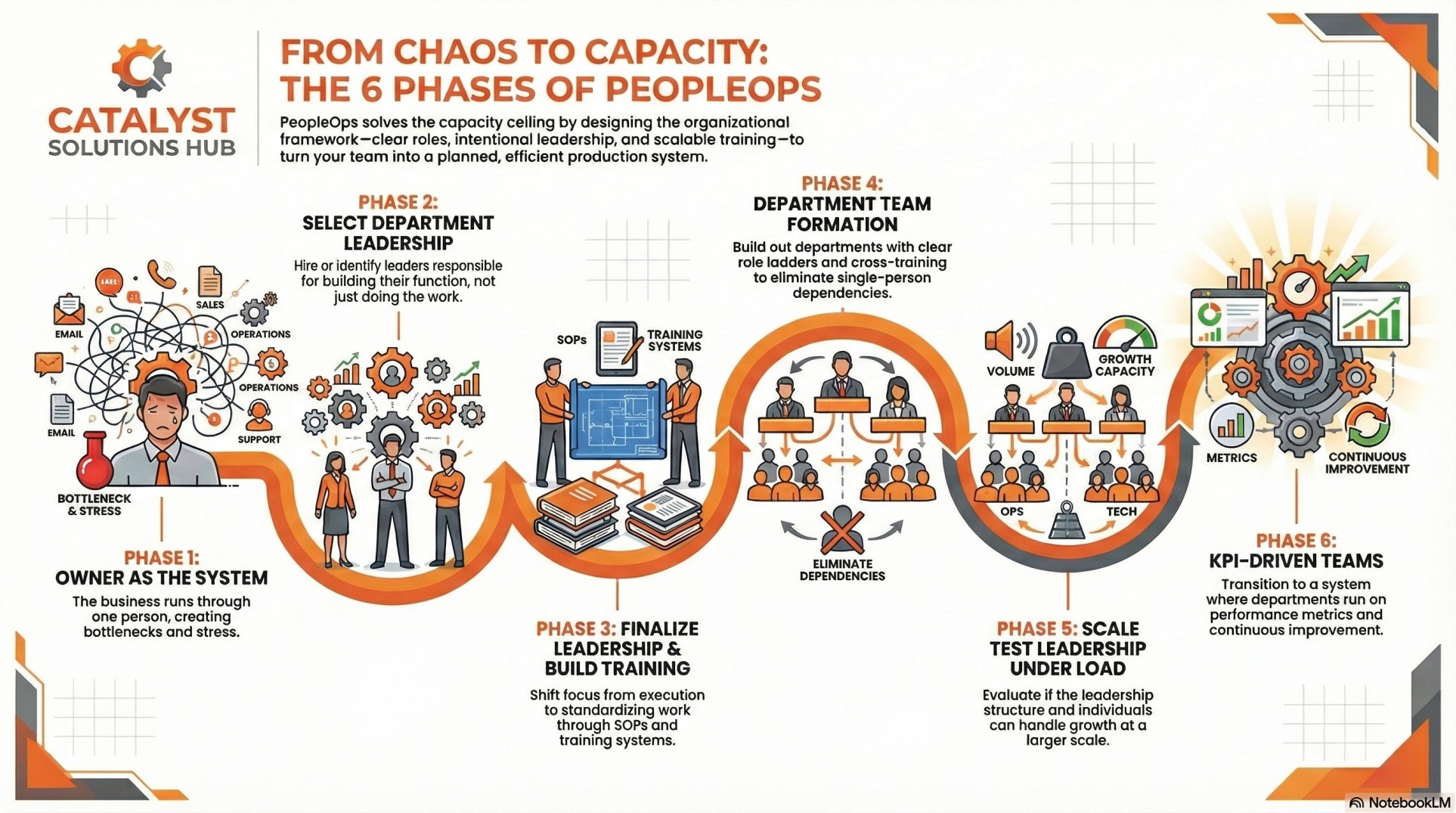
Phase 1 — Owner / Manager as the System
The business runs through one or two people.
Knowledge, decisions, and execution are centralized.
What breaks:
- Bottlenecks everywhere
- No clear ownership
- Growth increases stress, not output
PeopleOps focus:
- Core function mapping
- Minimum role clarity
- Initial capacity snapshot
- Basic accountability cadence
Phase 2 — Select Department Leadership
Leadership must be identified or hired here — not later.
This role owns the function and is responsible for building it, not just doing the work.
PeopleOps focus:
- Department lead role scorecard
- Leadership capability requirements
- 30/60/90 ramp plan
- Definition of what the leader must build (training, standards, handoffs)
Phase 3 — Finalize Leadership + Build Training
Leadership is now tested.
The focus shifts from execution to training and standardization.
PeopleOps focus:
- Train-the-trainer framework
- Initial SOPs and checklists
- Quality standards and “definition of done”
- Documented feedback loops
Phase 4 — Department Team Formation + Redundancy
Departments become real and no longer depend on one person.
PeopleOps focus:
- Role ladders (entry → intermediate → senior)
- Cross-training and coverage planning
- Department operating cadence
- Hiring plan tied to demand
Phase 5 — Scale Test: Leadership Under Load
Leadership already exists — now it is evaluated at scale.
This is where you determine:
- Can leadership grow with the company?
- Do they need development?
- Does the structure need to change?
PeopleOps focus:
- Leadership capability assessment
- Develop vs restructure vs replace decision framework
- Leadership team operating model
- Cross-department handoff clarity
Phase 6 — KPI-Driven Teams + Continuous Improvement
Departments run on performance, not effort.
PeopleOps focus:
- Department KPIs tied to outcomes
- Performance management system
- Capacity-to-demand visibility
- Continuous improvement for people and process
Labor Built From Volume (Not Guesswork)
PeopleOps starts with volume — sales, projects, units, or throughput.
From volume, we model:
- Required roles
- Headcount per role
- Leadership layers
- Loaded labor cost
- Hiring breakpoints
Labor becomes a calculated system, not a surprise.
Current-State Labor Budget
We define what the workforce should look like at today’s volume.
This includes:
- Minimum viable roles
- Where leadership is acting as labor
- Cost of the current structure vs the correct one
Future-State Labor Budget
We model labor at higher volume targets.
Scenarios include:
- Conservative growth
- Target growth
- Aggressive growth
Each scenario includes:
- Headcount by role
- Leadership needs
- Estimated labor cost
- Hiring order and timing triggers
Why Labor Costs What It Costs
Labor cost is driven by role requirements, not just pay rate.
We account for:
- Skill and experience level
- Decision-making responsibility
- Training time to proficiency
- Management overhead
- Redundancy and coverage needs
The Hiring Plan
Hiring becomes intentional, not reactive.
We define:
- What role comes next
- What must be built before that hire
- When volume triggers the hire
- What “ready to hire” actually means
Technology as a Labor Lever
If controlling labor cost matters, we model where tech can help.
We identify:
- Tasks that can be automated
- Roles that can be partially supported by systems
- Where tools increase capacity per person
This connects directly to TechOps and SmartOps.
Training That Scales Inside Departments
We don’t just create training — we teach leaders how to build training systems.
This includes:
- Train-the-trainer framework
- SOP and checklist templates
- Onboarding and ramp paths
- Promotion and growth criteria
Feedback Loop Audits
We document where people struggle and why.
We analyze:
- Repeated mistakes
- Failed handoffs
- Quality breakdowns
- Missing or unclear training
- Ownership gaps
Then we decide what to fix:
- Training
- Process
- Tools
- Role design
- Staffing or leadership structure
Before FlowOps
PeopleOps ensures:
- Clear ownership
- Capable leadership
- Roles designed for scale
Without this, FlowOps accelerates chaos.
After PeopleOps
Once structure is solid:
- FlowOps optimizes work movement
- TechOps supports people with systems
- SmartOps reduces labor through automation
PeopleOps is the foundation everything else depends on.
Ready to Start?
Want a quote or to inquire about pricing on a project please get a time scheduled.
Skills That Make a Meaningful Difference for Your Business
Cras a elit sit amet leo accumsan volutpat. Suspendisse hendreriast ehicula leo, vel efficitur felis ultrices non. Cras a elit sit amet leo.
STRATEGY ACCELERATION
90%
REVENUE GROWTH
80%
FIREWALK SALES
50%