
“Quit hiring more people to do less work — you don’t have a staffing problem, you have a workflow problem.”
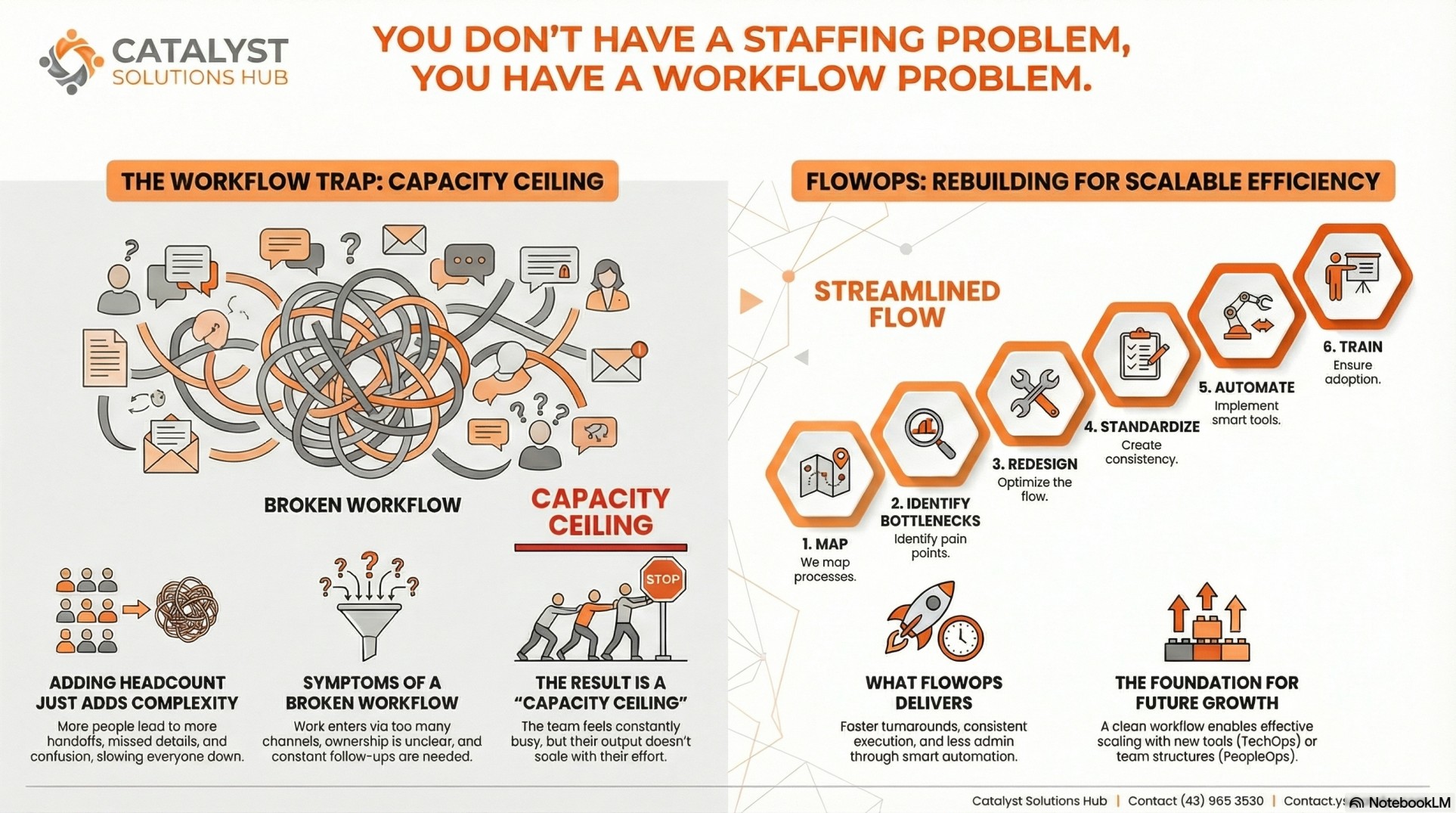
When your workflow is unclear, adding headcount adds complexity. More people means more handoffs, more follow-ups, more missed details, and more “who’s doing what?” The problem isn’t effort—it’s that the process is leaking time at every transition. FlowOps fixes the system first so any hiring you do later actually multiplies output instead of multiplying chaos.
Work enters through too many channels (email, texts, calls, verbal requests)
Requirements aren’t captured upfront, so the team guesses and reworks later
No clear owner for the next step, so items sit “in limbo”
Status isn’t visible unless you ask someone (meetings become the dashboard)
Approvals and decisions stall because there’s no defined route or standard
Every project runs differently depending on who is involved
Before: scattered intake, unclear ownership, inconsistent steps, constant follow-ups
After: one clean intake path, defined ownership, standard handoffs, automated follow-through
We build a workflow your team can run without relying on memory, heroics, or micromanagement—so execution becomes consistent and scalable.
Map your current workflow (how work truly moves today)
Identify bottlenecks and failure points (handoffs, rework loops, approvals)
Redesign the flow (future-state) with ownership and clean transitions
Install standards (templates, checklists, definitions of “done”)
Automate the repeatable steps (routing, reminders, status updates, reporting)
Train and adjust after launch so the team actually adopts it
Current-state and future-state workflow maps
Ownership + handoff structure (who owns what, when, and how)
Intake + handoff templates (so work enters clean)
SOP-lite checklists (simple, usable, followed)
Automation plan (what to automate first + why)
Visibility/KPI plan (cycle time, backlog, stuck work, workload)
FlowOps is for teams that are busy, growing, and feeling operational drag—where output isn’t scaling with effort. If your operation depends on a few key people keeping everything in their heads, if work stalls in handoffs, or if you’re constantly chasing status updates, FlowOps is built for you.
After the workflow is rebuilt and operating cleanly, you can expand into deeper tooling (TechOps), role clarity and accountability systems (PeopleOps), or keep a light monthly optimization cadence to refine the workflows as the business evolves.
FlowOps creates the operating flow. What comes next depends on what you need to scale.
PeopleOps (align roles + ownership)
If the real issue is unclear responsibilities, missing seats, or a department that’s growing faster than the structure—PeopleOps comes first or runs alongside FlowOps. We define roles, ownership, expectations, and handoffs so the workflow has real accountability behind it.
TechOps (tooling + system build)
Once the workflow is clean, TechOps turns it into a working system inside your tools: pipelines, forms, task structures, integrations, dashboards, and automation that makes the workflow run with less manual effort.
SmartOps (AI + automation acceleration)
After the process and tooling are stable, SmartOps adds leverage: AI-assisted intake, document parsing, routing suggestions, auto-updates, and reduced admin load. This is where you start lowering labor cost per unit of work and increasing throughput without adding headcount.
FlowOps works best when we have enough clarity to map the real flow and install ownership. If you’re not there yet, we typically start with one of these:
If you don’t have clear ownership or roles → start with PeopleOps
When responsibilities are vague, FlowOps becomes “a nice map” but doesn’t stick. PeopleOps sets the foundation: who owns what, what “good” looks like, and how departments work together.
If your tools are chaotic but the workflow is clear → start with TechOps
If you already know the steps but execution is messy because tools aren’t set up, TechOps can stabilize the system quickly.
If everything feels unclear → start with a Workflow Diagnostic
We identify where work enters, where it gets stuck, and what’s causing rework. Then we recommend the right sequence: PeopleOps, FlowOps, TechOps, SmartOps—or a combination.
Want a quote or to inquire about pricing on a project please get a time scheduled.
Cras a elit sit amet leo accumsan volutpat. Suspendisse hendreriast ehicula leo, vel efficitur felis ultrices non. Cras a elit sit amet leo.