- Home
- About Us
- Services
- TaskOps – On-Demand Project Services for Precision & Efficiency
- FlowOps – Optimizing Workflow & Process Automation
- PeopleOps – Building Stronger Teams & Scalable Workforce Infrastructure
- SalesOps – Optimized Sales Strategy & Revenue Growth
- TechOps – Connected Tools, Clean Data, Real-Time Control
- IntegrationOps – Unifying Processes, Technology & Asset Management
- SmartOps – AI, Automation & Smart Data for Operational Excellence
- Work
- Resources
- Team
- Contact Us
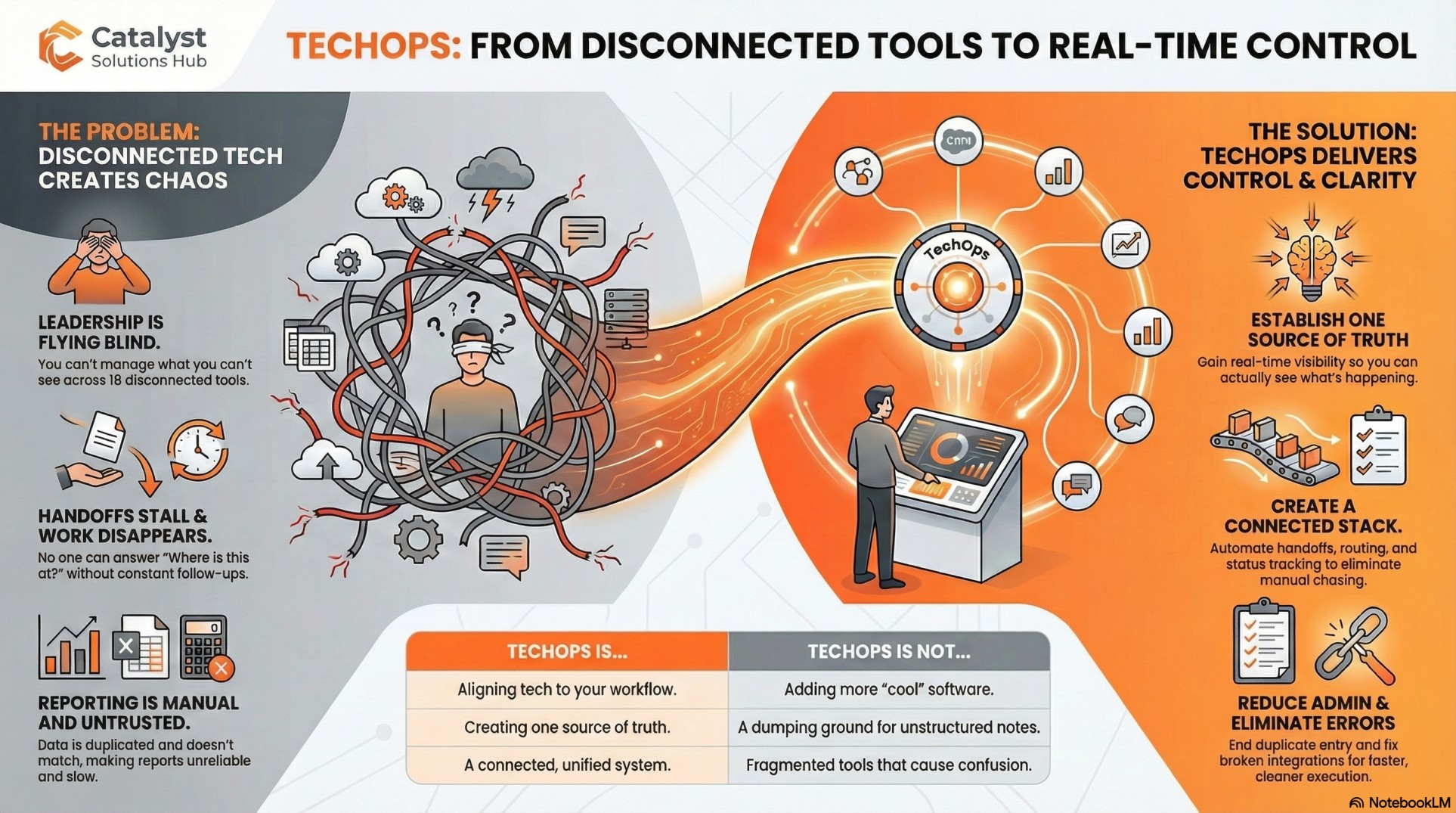
“You can’t manage what you can’t see—and 18 disconnected tools guarantee you won’t see it.“
Most growing companies don’t lose control because the team can’t work. They lose control because the tech stack can’t tell the truth. Data lives in 18 places, tools don’t talk, ownership is unclear, and every handoff turns into “Who has it?” and “Where is the latest version?” The result is the same pain: constant follow-ups, duplicated entry, and leadership flying blind—because you can’t manage what you can’t see.
TechOps connects your tools, cleans your data, and builds the triggers, handoffs, and reporting that make your workflows run as one system. Instead of software being “a place to store stuff,” TechOps makes technology an operating layer: clear inputs, defined transformations, consistent outputs, and real-time visibility—so your tech supports the flow, not fights it.
What TechOps delivers:
1. Real-time visibility and control by establishing one source of truth (so leadership can actually see what’s happening)
2. A connected stack where tools work together—automated handoffs, routing, and status tracking instead of manual chasing
3. Less admin, fewer errors, and faster execution by eliminating duplicate entry, tool overlap, and broken integrations
TechOps is the systems layer that makes your People structure and Flow actually run end-to-end. We turn the workflow into a connected operating system: clear inputs, defined ownership, tracked handoffs, and consistent outputs—so leadership can see what’s happening without chasing people.
TechOps focuses on:
- One source of truth (where each record lives and who owns it)
- Connected tools + clean data
- Handoffs, triggers, automation, and visibility that match the workflow
TechOps isn’t “more software.” It’s not a dumping ground for notes, and it’s not 18 tools tracking fragments of the business.
TechOps is not:
- Adding tools because they’re “cool” or have features
- Storing information without structure or ownership
- Fragmented systems that create duplicate entry and confusion
TechOps is:
- Aligning technology to the workflow
- Removing overlap and friction
- Building a system your team can actually operate
If you recognize these, you don’t have a people problem—you have a systems problem.
- Data is duplicated and doesn’t match across tools
- No one can answer “Where is this at?” without asking around
- Handoffs stall and everything becomes follow-ups
- Reporting is delayed, manual, or untrusted
- You keep adding tech but visibility doesn’t improve
- Throughput doesn’t scale with effort
This is where control comes from.
A stack that supports your people instead of forcing them to work around it
Real-time visibility because the system can tell the truth
Less admin + fewer misses by eliminating duplicate entry and broken handoffs
Faster execution through standardized statuses, ownership, and automated routing
Better decisions with dashboards and KPIs tied to the real workflow
We build the operating layer underneath the business.
Governance: permissions, standards, and rules so the system stays clean
System blueprint: data objects, statuses, required fields, naming standards
Source of truth rules: what lives where + who owns updates
Connected stack: integrations that reduce manual work and keep tools aligned
Workflow enforcement: triggers, routing, approvals, reminders, task creation
Visibility layer: dashboards, KPIs, and operating rhythm reports
We don’t start with tools. We start with how work moves—then design technology to support that flow.
Adoption + Training (role-based training so it sticks)
Audit + Reality Check (tools, data, workflow breakdowns)
System Blueprint (source of truth, ownership, statuses, handoffs)
Stack Alignment (keep what works, cut what hurts, consolidate)
Implementation + Integration (configure tools, connect them, enforce standards)
Reporting + Control (dashboards + KPIs you can trust)
We have SmartOps for AI—but we don’t bolt AI onto messy systems.
If your tools are disconnected and your data is inconsistent, AI won’t create insight—it will generate confident answers from unreliable inputs and amplify chaos through automation.
TechOps makes AI possible by building:
- Clean inputs and standardized data
- One source of truth
- Defined workflow triggers and ownership
- Trackable outputs and reporting
Then SmartOps (AI) can actually work—because the system is organized enough to trust the results.
You don’t just get recommendations—you get a working system and rules to keep it clean.
Governance rules + training materials
Tech stack map + workflow map
System blueprint (data model, statuses, ownership, handoffs)
Configured tools + integrations + automations (non-AI)
Dashboards + KPI definitions
Do you replace all our tools?
No. We keep what works, remove overlap, and connect what matters.
Do you do AI inside TechOps?
No. AI is SmartOps. TechOps is the foundation that makes SmartOps effective.
What if we want AI right now?
We’ll show you what must be standardized first so AI doesn’t run on bad data.
How do we keep the system from falling apart later?
Governance + ownership + required fields + training. We build the guardrails.
TechOps works when there’s enough clarity in how work moves and who owns it. If the workflow and ownership are still fluid, TechOps turns into “configuring chaos.”
You’re ready for TechOps when:
- You can clearly describe your core workflow from intake → delivery → closeout
- Roles have defined ownership (who owns the step, the data, and the output)
- You have a basic set of statuses/steps you want enforced
- Leadership agrees on what “the truth” should be (what needs tracking and why)
If that’s not true yet, don’t worry — we start one layer earlier.
We start with the bottleneck that’s currently creating the most friction.
Start with PeopleOps when:
- Roles are unclear or constantly shifting
- Accountability is inconsistent (“everyone owns it” = no one owns it)
- You’re hiring without a clear structure or capacity model
- Training and expectations aren’t standardized
Start with FlowOps when:
- Work enters messy and handoffs break
- Steps aren’t standardized (everyone does it their own way)
- Follow-ups and rework are normal
- Cycle time is unpredictable
Start with TechOps when:
- The workflow is mostly known, but your tools don’t enforce it
- Data is duplicated across systems and reporting can’t be trusted
- “Where is it at?” requires asking people
- You need integrations, automation, and real visibility to scale
Simple rule:
PeopleOps defines who. FlowOps defines how. TechOps builds the system that makes it run.
We don’t force TechOps. We stabilize the foundation quickly so TechOps is worth doing.
We’ll run a short “Foundation Sprint” to:
- Identify the real workflow (inputs → outputs)
- Define ownership + required data at key steps
- Standardize basic statuses and handoffs
- Establish what the business must be able to see (KPIs + visibility needs)
Then we implement TechOps on top of a workflow that’s stable enough to automate and report on.
Once TechOps is in place, SmartOps becomes the acceleration layer.
TechOps gets you: clean inputs, connected tools, one source of truth, and real reporting.
SmartOps uses that structure to apply AI safely and effectively—without hallucinations, garbage outputs, or automation that amplifies chaos.
SmartOps typically adds:
- AI summaries that write into structured fields (not random notes)
- Automated routing and prioritization based on content and rules
- Drafting client updates, RFIs, follow-ups, and internal action plans
- Data extraction from PDFs/emails into your system reliably
- Predictive insights (because the data is finally clean enough to trust)
Bottom line: TechOps makes the system truthful. SmartOps makes it faster.
Ready to Start?
Want a quote or to inquire about pricing on a project please get a time scheduled.
Skills That Make a Meaningful Difference for Your Business
Cras a elit sit amet leo accumsan volutpat. Suspendisse hendreriast ehicula leo, vel efficitur felis ultrices non. Cras a elit sit amet leo.
STRATEGY ACCELERATION
90%
REVENUE GROWTH
80%
FIREWALK SALES
50%
